Final Piece
For my narrative and sequence module, we are looking at artists books, and how they can be presented. I've decided for my final piece to make an artist book in the shape of a fan, because I'm interested in historical society, particularly the Georgian and Victorian eras, and fans were an important tool for the higher class, because there was a hidden language in them.

In
the 18th century, fans were a common
fashion accompaniment. They could be made from very expensive ivory and
silk to cheap wood and paper. Most were around 10 to 12 inches long,
and had some general
characteristics: 3 images/scenes, curly floral decorations;
and sticks with some space in between.
The language of the fan became an important part of a lady's expression and body language, commonplace at dinner
parties, balls and social gatherings, as they could send messages
across a room without saying a word. Here are some of the signals and what they mean:
Firstly,
I started off by making some simple paper fans, following an origami
tutorial. It was fairly easy, but it works better with a thinner paper
so you can get a more precise fold.


I
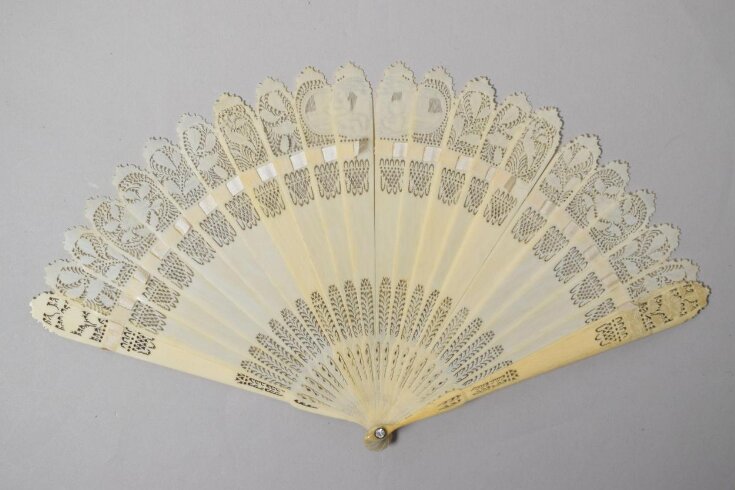
then looked at different types of hand fans. The most common folding
fans are the ones shown above, but there was also the brisé fan, a type
of fan that doesn't have the decorative paper or silk pleated to the
sticks. You can still portray an image across multiple sticks though, or
carve ornate patterns into each one, especially if they're ivory.


I'm
figuring out the mechanisms of the fan by trying to make my own sticks
and attaching them at the base. I did this maquette with card and paper,
whilst it looks better than the constantina folded fan, it was flimsy
and didn't open and close very well.


Another
attempt, this time using a split pin as the fan hinge, and with cloth
from the scrap store instead. This one moved a bit better, but is still
stiff, so I'm getting a consultation with the fabrication department to
get help with making the fan sticks.

I
had a quick look at different fashion periods from early to late 19th
century. I decided to base these fans off the Regency time period the
early 1800s.


These are some storyboards for the vignettes.

After
having a tutorial, and thinking about the feasibility of creating 3
wooden fans, i've decided to slightly change the outcome look, and make 3 fans
out of card. This still keeps with the time period because regency era
people would have dance cards at parties, and they were often shaped
like fans. These shapes also give me more room to add drawings and
patterns.


For
the two brackets either side of the fan I'm going to laser cut these
floral designs. These flowers are also specific to this time period as
they're floriography, a popular Victorian communication system through
flower arrangements.

I
also managed to visit the V&A museum in London, and had a close up
look at some fans and dresses from the regency era. I love how how
simple and elegant the long, Grecian style dresses look. And how pretty
the fans are as an accessory


I’m now starting to put together the fan blades in Photoshop and adobe illustrator. This quick mock-up hopefully shows what it will look like assembled

Here's
the finished drawings on Photoshop ready to be printed. The 3 animals,
butterflies, hares and cardinals, represent nervousness, the chase and
loss. For the first fan I included the ladies hand reaching out, the
middle fan, two hands clasped together in dance, and the last one the
gentleman's hand pulling away. I also included a pattern on the back of
the fans of their feet walking separately and dancing together. For this
I looked at dance maps of the waltz. The musical notes are also from
one of mozarts' pieces.


These
are the final fans for my narrative and sequence module. I laser cut,
etched, and painted the wooden brackets and laser cut each fan blade. To
hold it together, I realized that the 1cm diameter hole was too big for
screws with the 5mm length I wanted, and after a lot of looking on
websites for special made screws, I got the idea to use screw in ear
stretchers. They were the perfect length for the fan and I could choose
the exact gauge I needed. The ones I bought also had pretty diamonds
which I think add to the fanciness of the fans.


Comments
Post a Comment